Text, photography and video: Lena Reiner
“Call me when you are there. There is no one from the local Red Cross club at the moment, so the door will be closed”, Reinhard Breh ends the telephone call settling the appointment at the Friedrichshafen rescue station of the German Red Cross (DRK). There is currently a state of emergency here because of the corona virus. The parking lot of the local association is accordingly unusually empty. Breh greets friendly when he opens the door, points - keeping his distance - into the staircase: "We are at the top."
Having arrived in his office, he quickly clears his desk space, puts two chairs between the training manikin with protective clothing on and the door: "This way we can keep our distance." Stefan Martin, the deputy hygiene coordinator, comes in almost giving a handshake, quickly putting his hand back to his pocket, smiles and says: "We aren't supposed to do so." That being said, the conversation is already in the middle of the topic these days: hygiene measures, infection protection against the circulating coronavirus. "It is difficult to keep the virus in mind," comments Breh. They also noticed that in themselves. You have to keep reminding yourself that there is a danger, even if you can't see it. "We are laymen against all these great virologists," says Breh, "but what we know so far, it is highly contagious and particularly dangerous because you can be infected without knowing it."
Depending on the qualification, this could become a problem: "In the emergency medic area, it gets tight when five are not available."
You can tell that people have become more tolerant of the masks since you can see them everywhere in the media coverage: We had two suspected Covid patients who really ejected phlegm. So I'm glad when that goes into the mask, which I can change three or four times on the way. You know that this is transmitted via droplets. It is better to cough into the mask. I don't have to have this everywhere in the car, even if it is of course disinfected afterwards.[/et_pb_testimonial][et_pb_text _builder_version="4.4.7" custom_margin="1em|20%|0px|20%|false|true" custom_margin_tablet="|2%||2%|false|true" custom_margin_phone="" custom_margin_last_edited="on|tablet"]Even protective clothing, which was scarce throughout Germany, was sufficiently available: "We only had half a week in which we were a bit thin with the protective clothing in one area or another." Stefan Martin and he had already at the beginning of January namely adjusted to the upcoming exceptional situation. "Everyone still thought: China is far away," Martin recalls. With a shrug, he adds, it is now relative with the "far away": "Planes make it possible." As a first step, they had increased storage capacity in January, bought more protective clothing and stored it, made "everything safe", then manuals and Recommendations for employees compiled. "I still remember that we had a quality management audit in mid-January," recalls Breh, laughing, "and our auditor was very surprised that everything was already in place." Ultimately, they are now glad that they have everything ready so early even if Breh notes: “In retrospect, I would say we should have increased the storage capacity again. But nobody could have guessed that."[/et_pb_text][et_pb_text _builder_version="4.4.7" custom_margin="1em|20%|0px|20%|false|true" custom_margin_tablet="|2%||2%|false|true" custom_margin_phone="" custom_margin_last_edited="on|tablet"] Because protective clothing plays a special role these days, Breh and Martin explain the additional challenge this poses. In particular, taking off the protective clothing needs to be learned so that the paramedics do not come into contact with the contaminated surfaces of the protective clothing when undressing. While Martin and Breh explain, DRK Lucy Hartle shows what the correct handling looks like. This is how this little explanatory video was created:[/et_pb_text][et_pb_video src="https://www.youtube.com/watch?v=ZQ0OAbIBz7U&feature=emb_title" _builder_version="4.4.7"][/et_pb_video][/et_pb_column][/et_pb_row][/et_pb_section]
Even protective clothing, which was scarce throughout Germany, was sufficiently available: "We only had half a week in which we were a bit thin with the protective clothing in one area or another." Stefan Martin and he had already at the beginning of January namely adjusted to the upcoming exceptional situation. "Everyone still thought: China is far away," Martin recalls. With a shrug, he adds, it is now relative with the "far away": "Planes make it possible." As a first step, they had increased storage capacity in January, bought more protective clothing and stored it, made "everything safe", then manuals and Recommendations for employees compiled. "I still remember that we had a quality management audit in mid-January," recalls Breh, laughing, "and our auditor was very surprised that everything was already in place." Ultimately, they are now glad that they have everything ready so early even if Breh notes: “In retrospect, I would say we should have increased the storage capacity again. But nobody could have guessed that."[/et_pb_text][et_pb_text _builder_version="4.4.7" custom_margin="1em|20%|0px|20%|false|true" custom_margin_tablet="|2%||2%|false|true" custom_margin_phone="" custom_margin_last_edited="on|tablet"] Because protective clothing plays a special role these days, Breh and Martin explain the additional challenge this poses. In particular, taking off the protective clothing needs to be learned so that the paramedics do not come into contact with the contaminated surfaces of the protective clothing when undressing. While Martin and Breh explain, DRK Lucy Hartle shows what the correct handling looks like. This is how this little explanatory video was created:[/et_pb_text][et_pb_video src="https://www.youtube.com/watch?v=ZQ0OAbIBz7U&feature=emb_title" _builder_version="4.4.7"][/et_pb_video][/et_pb_column][/et_pb_row][/et_pb_section]
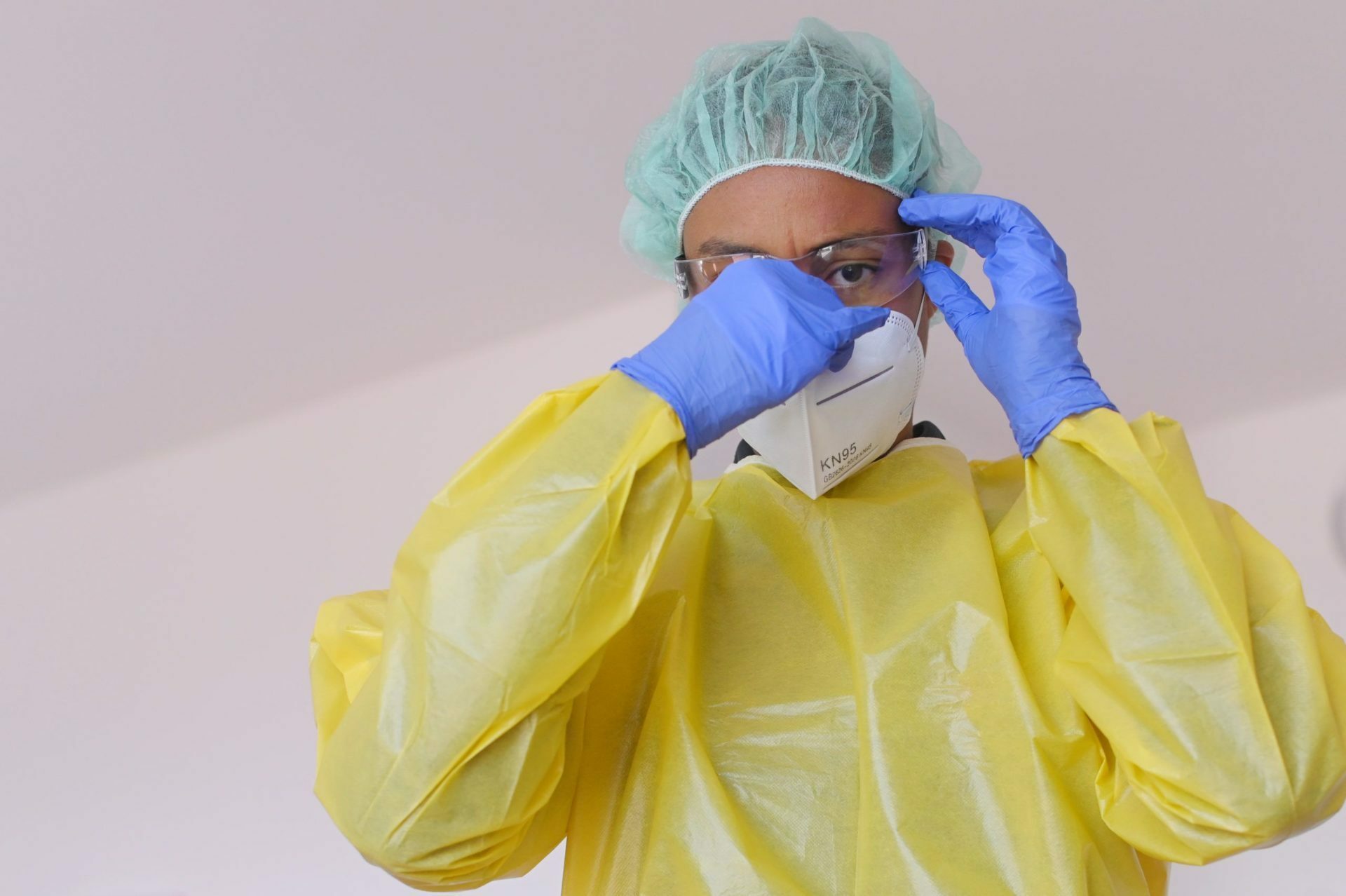
Because protective clothing plays a special role these days, Breh and Martin explain the additional challenge this poses. In particular, taking off the protective clothing needs to be learned so that the paramedics do not come into contact with the contaminated surfaces of the protective clothing when undressing. While Martin and Breh explain, DRK Lucy Hartle shows what the correct handling looks like. This is how this little explanatory video was created:[/et_pb_text][et_pb_video src="https://www.youtube.com/watch?v=ZQ0OAbIBz7U&feature=emb_title" _builder_version="4.4.7"][/et_pb_video][/et_pb_column][/et_pb_row][/et_pb_section]
Because protective clothing plays a special role these days, Breh and Martin explain the additional challenge this poses. In particular, taking off the protective clothing needs to be learned so that the paramedics do not come into contact with the contaminated surfaces of the protective clothing when undressing. While Martin and Breh explain, DRK Lucy Hartle shows what the correct handling looks like. This is how this little explanatory video was created:[/et_pb_text][et_pb_video src="https://www.youtube.com/watch?v=ZQ0OAbIBz7U&feature=emb_title" _builder_version="4.4.7"][/et_pb_video][/et_pb_column][/et_pb_row][/et_pb_section]